I just completed my internship with Leah Marone, LCSW, a corporate wellness consultant, through Gardhouse. Over the past six months, I have been exposed to a side of public health that I was previously unaware of. Working in workplace health and wellness with Leah Marone has allowed me to sharpen my research and data analytics skills as well as develop health and wellness communication skills. I assisted her in advertising her services and educating her audience by creating canva posts for her LinkedIn.


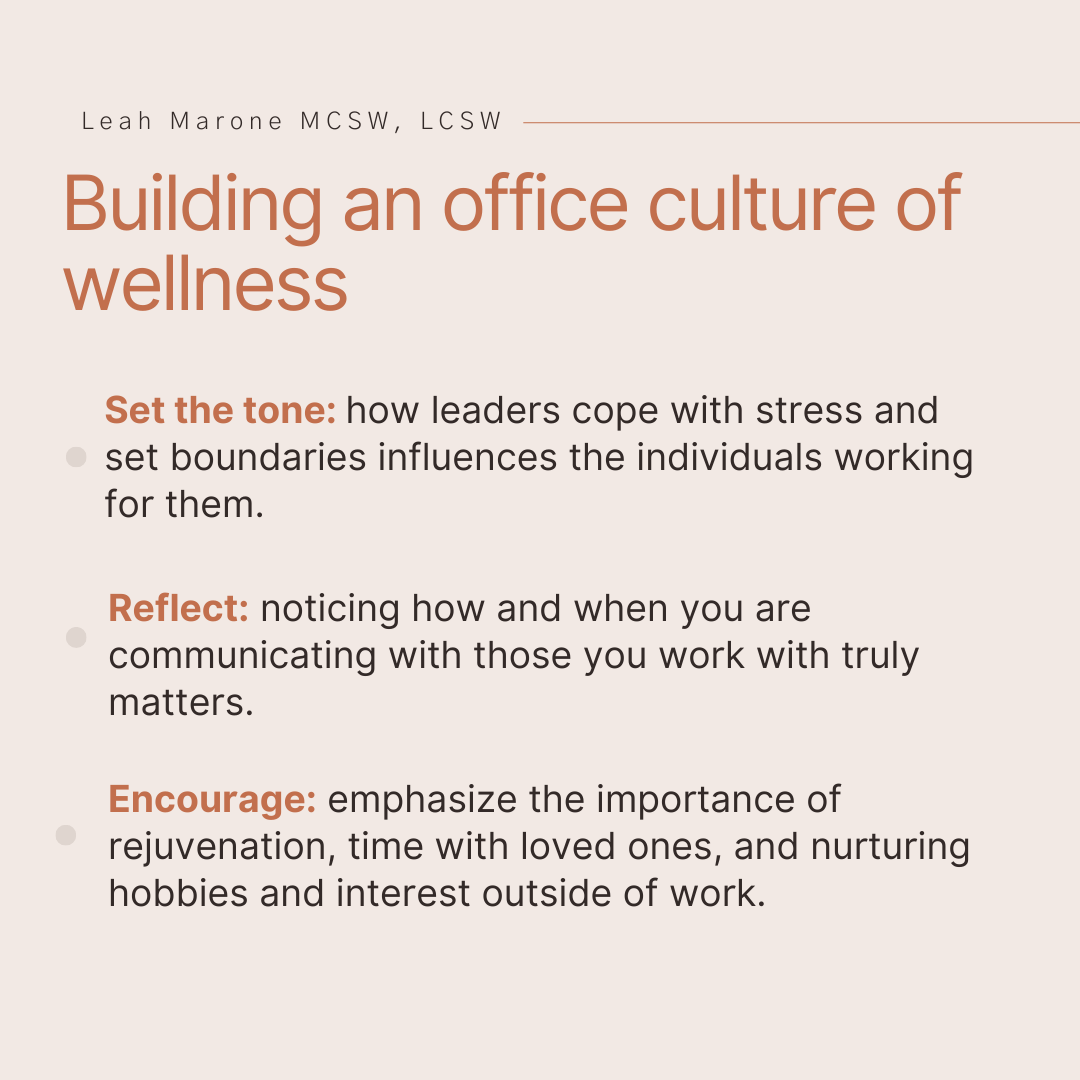
I was able to observe the development process of a group wellness intervention that Leah and Kristin Meyer organized; I also compiled resources for the intervention. My long-term project for this internship was market research on Charlotte employees’ perspectives on health initiatives and corporate wellness culture.
My research tested my practical application of statistical analysis, and my ability to manipulate data in R, gather relevant sources, and think critically about data and sources. I struggled quite a bit in this process but in turn, I have applicable skills for future research and found a love for data analytics.
My project consisted of surveys and interviews with Charlotte, North Carolina employees to gather insight into the current state of corporate wellness initiatives, corporate culture, and the desires employees have for the future. A review of the current literature was done to develop the survey and it was distributed through Linkedin. Factors such as age, gender, work modality, and corporate culture were analyzed alongside reported job stress contribution to overall stress.
It was found that among those surveyed employees working in-person reported the highest job stress contribution averaging 3.11 on a scale of 1 to 4 followed by remote workers averaging 2.53, and lastly hybrid workers at 2.21. Interviews were consistent with these results with multiple interviewees stating that hybrid was the preferred work modality due to flexibility while maintaining connections with other coworkers.
Gender did not show large differences in mean stress contribution with men averaging at 2.52 and women at 2.47. On average, baby boomers reported the least amount of job stress contribution at 2.4 while generation X reported the highest at 2.785.
Aspects of corporate wellness were measured alongside job stress contribution.
- Leadership support of health prioritization
- Pressure to be available outside of normal work hours
- Comfortability to advocate for mental health in the work environment
- Job interrupting life outside of normal work hours
- Encouragement to take breaks when needed
Aspects that seemed to have a large difference in mean job stress contribution were leadership encouragement of employee prioritization of health, Although the difference of means was not found to be significantly different by means of t-testing.
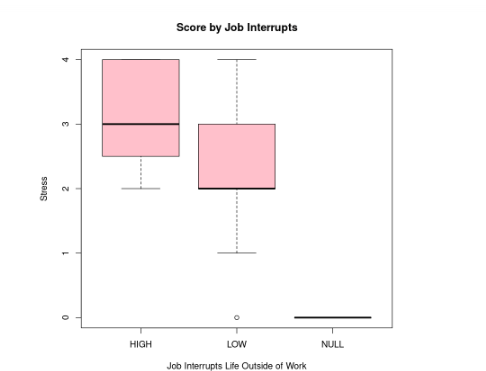
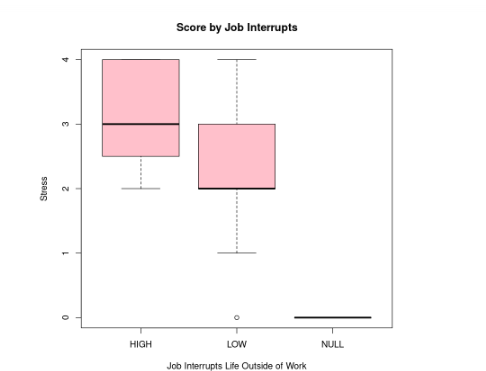
Pressure to be available to work outside of normal hours and incidence of job interrupting life outside of work hours were found to be statistically significant factors in job stress contribution. This means there was a large enough difference in means between those with high and low pressure to be available to work outside of normal hours and high and low incidence of job interrupting life outside of normal work hours.

The full paper has additional analysis and interviews. To read it click the link below.
 Sydney Lash